 Mirmi
Mirmi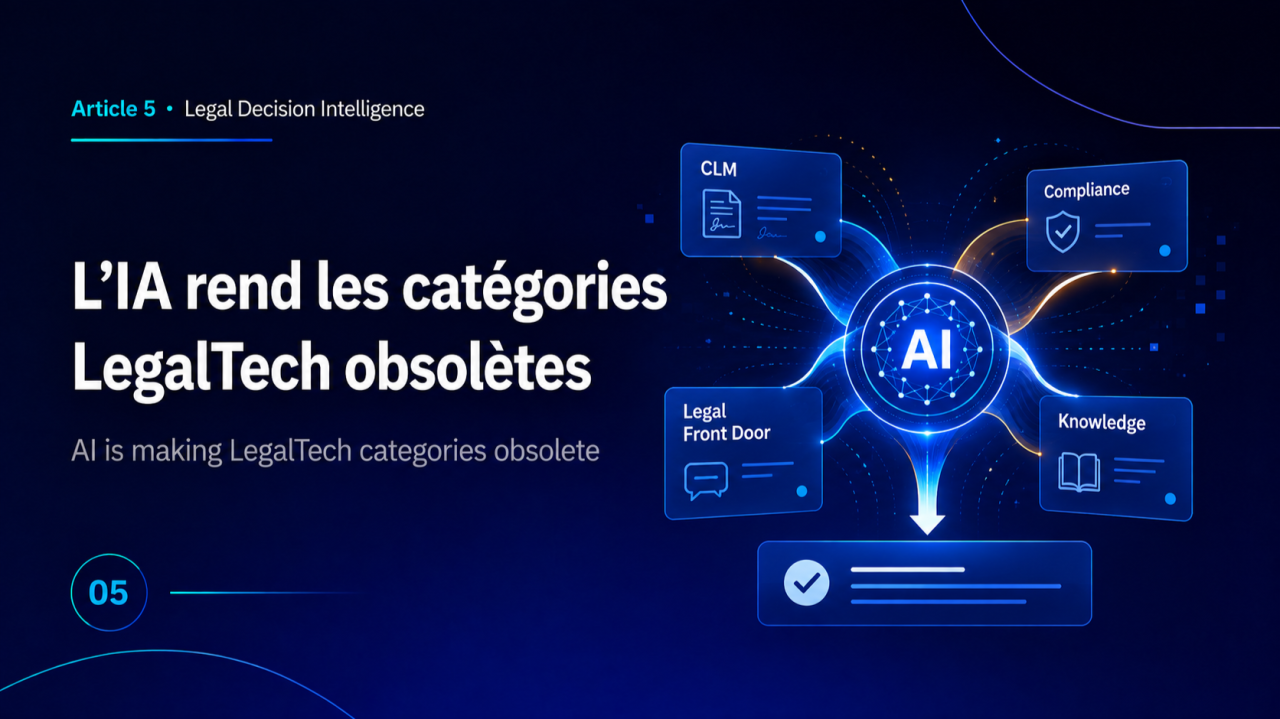
For a long time, one LegalTech product matched one specific problem: a CLM for contracts, a compliance tool for compliance, a Legal Front Door for legal requests.
But several legal departments are starting to do something far more interesting: use their tools for problems the vendor may never have imagined.
The Financial Times even refers to this as “off-label AI.” And behind the phrase may lie one of the most important shifts in legal software.
🔀 A contract tool used to review… political ads
Cox Media Group operates US television and radio stations. During elections, its teams need to review a large volume of political advertising quickly: an important source of revenue, but one that carries legal risks including defamation.
Rather than buying a specialised tool — for a market probably too small for such a product to exist — the legal team adapted technology originally used for contract review to analyse those ads before they aired. Cox’s General Counsel says this repurposing helps both secure the content and accelerate the sale of advertising inventory. (Financial Times, Bloomberg Law)
💡 First insight: AI lowers the minimum size a problem must reach before it is worth automating.
In traditional SaaS, a vendor needed hundreds or thousands of customers with almost the exact same problem to justify building a module. With a sufficiently adaptable architecture, a company can now automate an extremely specific workflow simply because that workflow creates enough value for that company.
A contract platform used to run internal investigations
The same phenomenon is happening at Nanyang Technological University in Singapore. The university uses Lexagle, a platform that originated in contract management, to structure misconduct cases: receiving reports, assessing them, tracking investigations and closing cases.
The reported result is concrete: the average time to close a case fell from 55 to 38.5 days, around 30% faster. And fewer than one third of reports now require an in-depth review, compared with more than half at the end of 2024. (Financial Times, Lexagle)
This case reveals something more interesting than the time saving itself: a large part of the value of contract software may have very little to do with contracts.
Collecting information, gathering documents, applying criteria, routing a case between several people, escalating specific situations and keeping a record of the final decision are also the building blocks of an internal investigation, a procurement approval or a compliance process.
🤖 Same technology, different business problems
At Endava, internal GPTs illustrate this logic even more clearly. One tool performs third-party screening by researching areas such as company ownership and available adverse information. Endava reports 40–50% time savings, with cases processed within 24 hours despite a 30% increase in demand. Another GPT performs an initial review of RFPs against jurisdiction-specific playbooks and reportedly cuts first-review time by up to 80%. (Endava)
NDAs, due diligence, RFPs, political advertising, internal investigations: the objects are different. The underlying intellectual building blocks are much less so.
Read unstructured information. Compare it with criteria. Identify exceptions. Produce a recommendation. Decide what can continue automatically and what should be escalated.
This is where traditional LegalTech categories start to become less relevant ... and start to explode. 🧨
💡 The best sign of a good LegalTech product may be a use case its vendor never anticipated
In the old software world, using a product for something other than its original purpose could look like a workaround. With AI, it can become a sign of quality.
If a legal team can adapt a tool to a new workflow without switching vendors, rebuilding integrations and launching a six-month project, the technology is probably capturing something deeper than the task itself.
It captures a reusable way of working.
And that suggests a new KPI for buyers: “time to second use case.” ⏳
How long does it take, after the first deployment, to automate a genuinely different second problem? Three days? Three weeks? Or do you need to buy another module, launch another RFP and start again from scratch?
That metric may say more about a platform’s ability to create long-term value than the number of features listed in its brochure. 🚀
⚠️ But “off-label” does not mean uncontrolled
This flexibility also creates a new governance problem.
A tool approved to analyse NDAs is not automatically approved to handle a sensitive HR investigation or support a decision with significant regulatory consequences.
Risk therefore needs to be assessed at the use-case level, not only at the vendor level: what data is being used? What is the consequence of an error? Who validates the output? Which decisions can genuinely be automated?
The more general-purpose platforms become, the more important this discipline becomes.
LegalTech RFPs may need to start with a different question
Not only:
“Do you have an NDA module?”
But:
“If tomorrow I want to apply this technology to three processes we have not identified yet, how much time and money will it take?”
CLM, Legal Front Door, Compliance and Knowledge Management categories are not going to disappear. But they were created in a world where software mainly automated a predefined process.
AI introduces a different logic: the same infrastructure can be reconfigured around new problems as they emerge.
That is also one of the principles behind Legal Decision Intelligence: value no longer sits only in the document or the module, but in the ability to reuse rules, information and decision mechanisms across multiple situations.
Your next major LegalTech use case may already exist inside your company.
You simply may not know yet that the tool you already bought can handle it. 🧠
This publication is based on an analysis first shared by Mirmi on LinkedIn.
View on LinkedIn