 Mirmi
Mirmi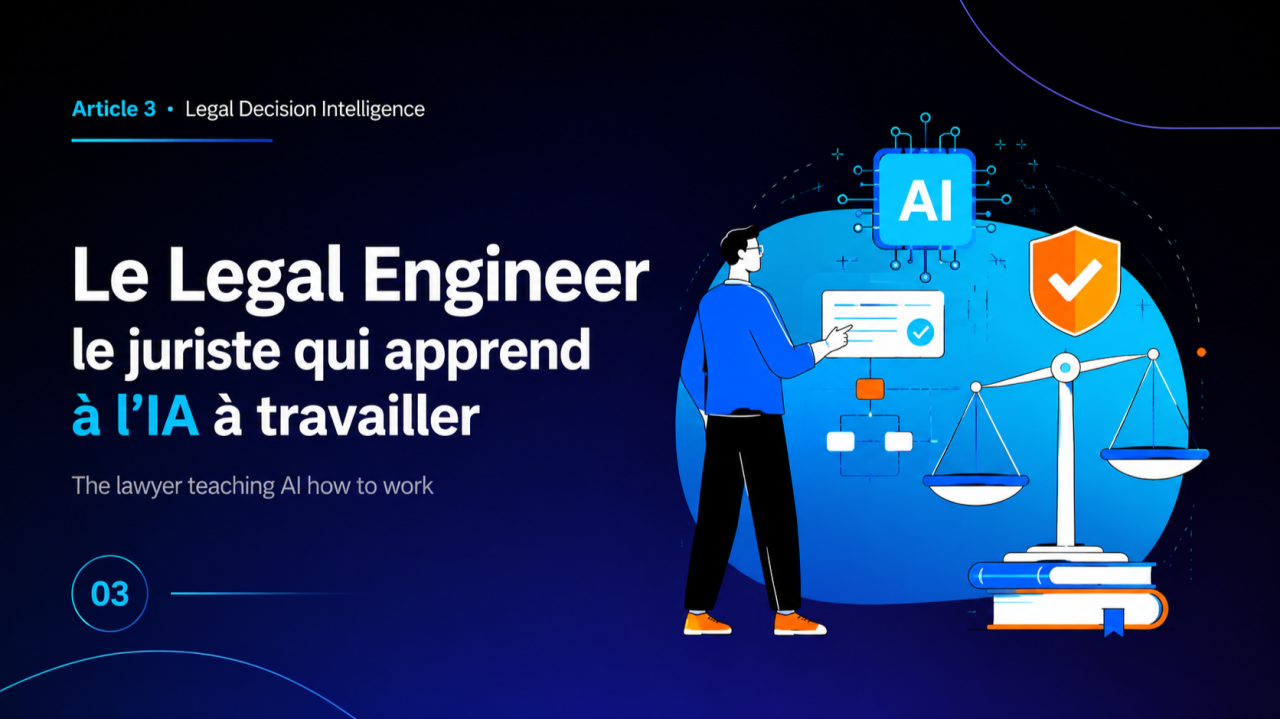
For years, lawyers and legal professionals had to learn how to use software designed by people who did not fully understand their work.
Today, some are leaving law firms to do exactly the opposite: teach software how to work like a lawyer.
Reuters recently published an article on the rise of Legal Engineers. Former lawyers are joining Harvey, Legora, Norm AI, Equall and Ivo to turn repetitive legal tasks into automated products. These companies are now hiring Legal Engineers by the dozen.
⚙️ A legal professional at the intersection of law, product and AI
A Legal Engineer is not necessarily a software developer. They are often a former lawyer or in-house counsel capable of translating legal reasoning into rules that a machine can understand.
Their role is to turn often implicit professional instincts into workflows, decision criteria and safeguards.
A general-purpose AI may know the law. But it does not naturally understand your organisation’s positions, exceptions, risk appetite or approval processes.
Between an impressive demonstration and a tool that can genuinely be used in practice, someone needs to understand the law, the technology and lawyers’ day-to-day work.
That is the gap the Legal Engineer fills.
🤖 Automating the work that made them hate the job
There is something slightly ironic about this trend.
Legal professionals leave their jobs because of endless reviews, repetitive checks and low-value tasks… and then join LegalTech companies to teach AI how to eliminate them. And it works.
Reuters cites a former Cleary Gottlieb associate who helped Norm AI automate the analysis of credit agreements in bankruptcy proceedings. Some workflows could reportedly reduce work that previously took dozens of hours to just a few minutes.
The best way to delegate an unpleasant task may soon no longer be to give it to a junior lawyer. It may be to turn it into software.
⚠️ But this creates an obvious risk
Repetitive tasks may be tedious, but they are also part of legal training.
Reviewing contracts, researching precedents and checking documents help junior lawyers understand details, structures and the consequences of a decision. If AI absorbs all entry-level work, how will tomorrow’s senior lawyers develop their judgement?
Legal Engineers will therefore need to decide not only what can be automated.
They will also need to determine which work genuinely deserves to disappear and which work remains necessary to learn the profession.
The role is not merely technical. It is deeply strategic.
Every legal department will need this capability
Not every company will hire a full-time Legal Engineer.
But almost every legal department will need to develop this capability, whether it is led by a Legal Ops professional, a tech-savvy lawyer, an innovation team or an external provider.
The real challenge will not be writing the perfect prompt. It will be formalising what should be automated, for whom, and according to which rules.
We are also beginning to see startups acting as “Legal Engineers as a Service,” such as Chamelio in the US and Mirmi AI in Europe. Their role is to make legal tools genuinely usable by business teams and turn past legal decisions into reusable organisational capabilities, based on a precise understanding of the context in which those decisions were approved or rejected.
In this model, lawyers are not replaced. Their reasoning becomes infrastructure.
The best Legal Engineers will probably not be the best coders or the lawyers who know the most legislation by heart. They will be the people who can clearly explain how a decision is made, which variables can change it and when human judgement remains indispensable.
For years, lawyers were asked to adapt to software.
The Legal Engineer may finally be the person who forces software to adapt to lawyers.
What about you: which legal task do you hate enough to want to teach an AI to do it?
This publication is based on an analysis first shared by Mirmi on LinkedIn.
View on LinkedIn